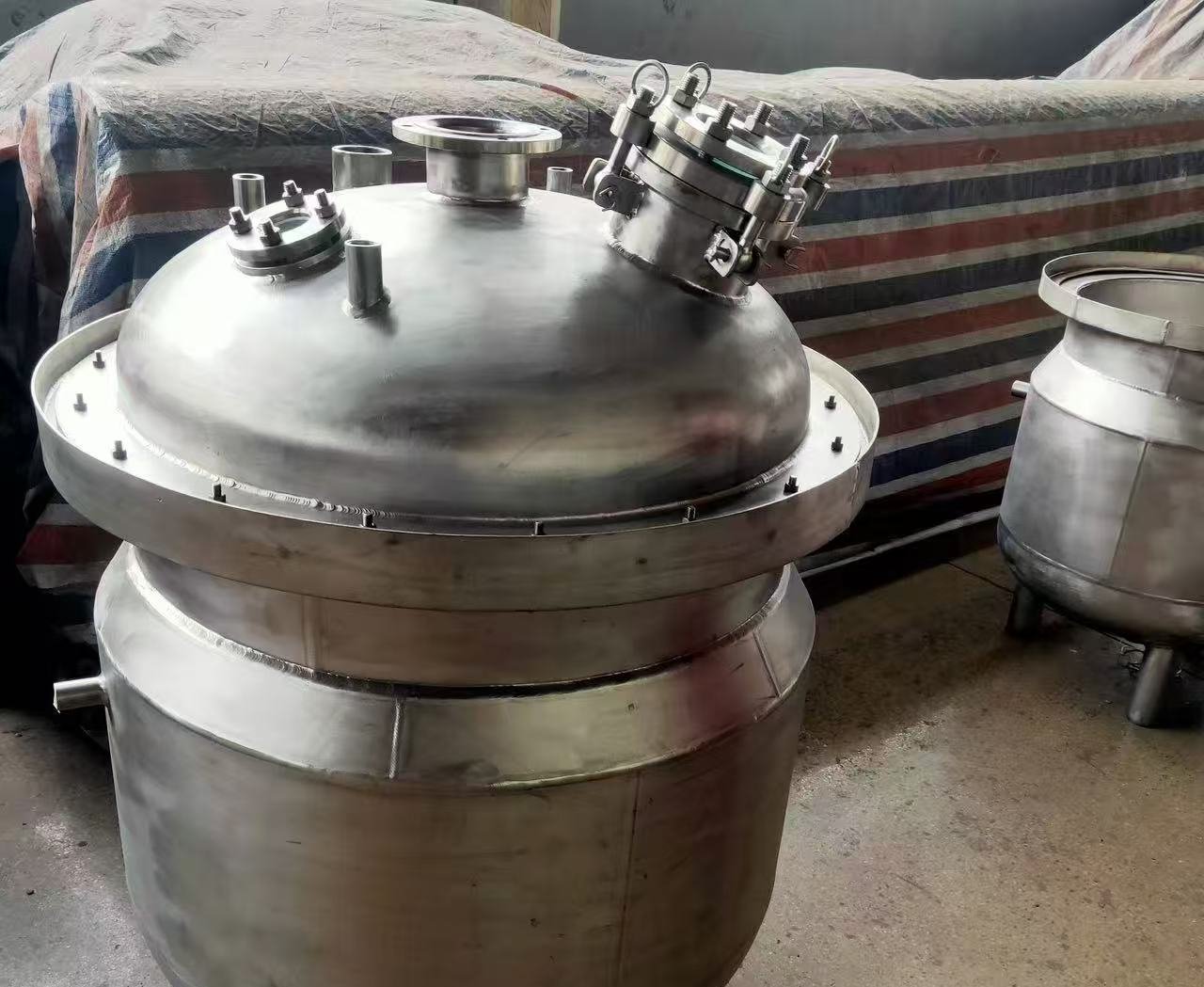
A reactor for a pharmaceutical API process is bought on four numbers, not on a price: a wetted-surface finish of Ra ≤ 0.4 µm, EN 10204 3.1 material certificates for the shell and every product-contact part, a mechanical seal that can be cleaned in place, and a cleaning validation supported by measured data rather than a claim. A 3,000 L jacketed vessel from China lands at USD 8,000–14,000 ex-works, and those four requirements decide where in that band it sits.
1. Choose the material family before you write the polish
Glass-lined, 316L and PTFE-lined vessels all serve API plants. The wrong first choice cannot be repaired later with a better surface finish.
Glass-lined is the corrosion answer. The borosilicate lining is inert to inorganic and organic acids, organic solvents and weak bases at various concentrations, and it is smooth as fired. It is not suitable for hydrofluoric acid, fluoride-bearing media, phosphoric acid ≥ 30 % above 180 °C, or strong alkali above pH 12 / 100 °C. Thermal shock limits are cold shock ≤ 110 °C and heat shock ≤ 120 °C — a 20 °C charge into a jacket at 150 °C is how linings fail.
316L is the documentation answer: GMP mirror polish, hygienic no-dead-corner geometry, sterile-grade mechanical seal available, and a mill certificate for every wetted plate. PTFE-lined — PFA, PTFE, ETFE (F40), ECTFE (F30), FEP (F46), spray or rotational coating — is the compromise for corrosive duty where glass-lined geometry or thermal cycling rules it out.
Test your cleaning solvent and your CIP caustic against the lining's media limits before you commit. Hot alkali is where glass-lined buyers get caught.
2. The Ra number, and what it does not prove
Rules of thumb worth writing into the enquiry: Ra ≤ 0.8 µm is a hygienic mechanical polish, Ra ≤ 0.4 µm is what most API buyers specify for product contact, and Ra ≤ 0.2 µm needs electropolishing and is hard to justify outside sterile injectables.
Ra is an average taken over a measured length on a sample surface. It does not describe the crevice under a baffle bracket, the undercut at a nozzle weld, the dead leg behind an instrument branch, or a gasket land that traps product. Two vessels can both report Ra 0.4 µm and behave completely differently in a rinse test.
So specify geometry alongside finish: flush-ground welds with no undercut, branch length no more than twice the bore (L/D ≤ 2), a zero-dead-leg bottom outlet, and PTFE or rubber-encapsulated PTFE gaskets with stainless or fluoropolymer-lined fasteners. Ask where the roughness measurements were taken and how many points were recorded on the report.
3. Material certificates: what 3.1 actually means
EN 10204 3.1 is a mill certificate issued against the specific heat that went into your vessel, not a generic compliance statement. 3.2 adds an independent authorised inspector's countersignature — worth the cost when your QA has to defend the file five years later.
Request 3.1 certificates for shell plate, heads, nozzles, agitator shaft and baffles, with heat numbers traceable to the nameplate or a heat-number map. Then read them. ASTM A240 requires 2.00–3.00 % molybdenum and 0.03 % maximum carbon for 316L; a certificate showing 1.6 % Mo is 316, not 316L, and it will pit in a chloride rinse.
Elastomers need their own paper: FDA 21 CFR 177.2600 and USP Class VI for gaskets and seal O-rings. Glass-lined vessels carry a lining test certificate instead — lining thickness in mm and high-voltage test in kV. PTFE-lined vessels carry a lining material certificate plus a holiday test record.
4. Cleaning validation starts on the drawing
You own the validation; the vessel either makes it easy or impossible. The design items that decide it are the CIP spray ball's coverage and flow, drainability to the outlet, the seal arrangement and the absence of horizontal ledges.
Agree acceptance criteria before fabrication: a riboflavin coverage test under UV at 365 nm with no residual film, rinse-water conductivity and total organic carbon at limits you set, and a defined worst-case product. The supplier can hand over the surface finish report, weld map and nozzle schedule to support that work. The protocol and the sign-off stay with you.
Be sceptical of "GMP certified". GMP is a state of control at your site, not a stamp on a vessel. What a workshop can give you is the evidence trail: 3.1 certificates, roughness measurements, weld maps, hydrostatic test records and, if you ask for it, third-party inspection by SGS.
5. Put it on one numbered sheet
- Design pressure, inner vessel and jacket, in MPa, with design temperature in °C.
- Product-contact material and certificate grade — 316L with EN 10204 3.1, or the lining specification.
- Surface finish: Ra value, method (mechanical or electropolished), number and location of measurement points.
- Seal: single, double or sterile-grade mechanical, with flush plan.
- Agitator type and motor power in kW, plus baffle arrangement.
- Nozzle schedule with sizes in mm and L/D for each branch.
- Test package: hydrostatic test, HV test in kV for glass lining, holiday test for PTFE lining.
- Documentation language and any third-party inspection requirement.
Model designation and nominal volume follow the industry-standard series, but internal dimensions, heat-transfer area, agitator power and unit weight depend on your duty — design pressure, jacket type, sealing arrangement and nozzle layout. We issue these eight items as a numbered specification confirmation sheet, which you approve before fabrication starts. Once it is signed, a change of polish or seal is a variation order, not a conversation.
6. What the GMP clauses cost
A 3,000 L jacketed glass-lined reactor with a mechanical seal is USD 8,000–14,000 ex-works. The GMP layer — 3.1 certificates, 0.4 µm polish, sterile-grade seal, full documentation package — is what moves a vessel from the bottom of that band to the top, and it is not a rounding error.
That is why the quotation has to be read line by line. If polish, certificates, seal and documentation do not appear as separate lines, the number that looks cheaper is a different vessel.
What to do next
Write the eight-item sheet before you ask for a price, not after. Send your media list, operating temperature range and CIP chemistry with it, because those three answers eliminate the wrong material family faster than any discussion of finish.
Then ask every supplier for the same sheet back, signed, with the Ra measurement method and certificate grade written on it. The reply that comes back with your numbers unchanged is the one worth auditing.