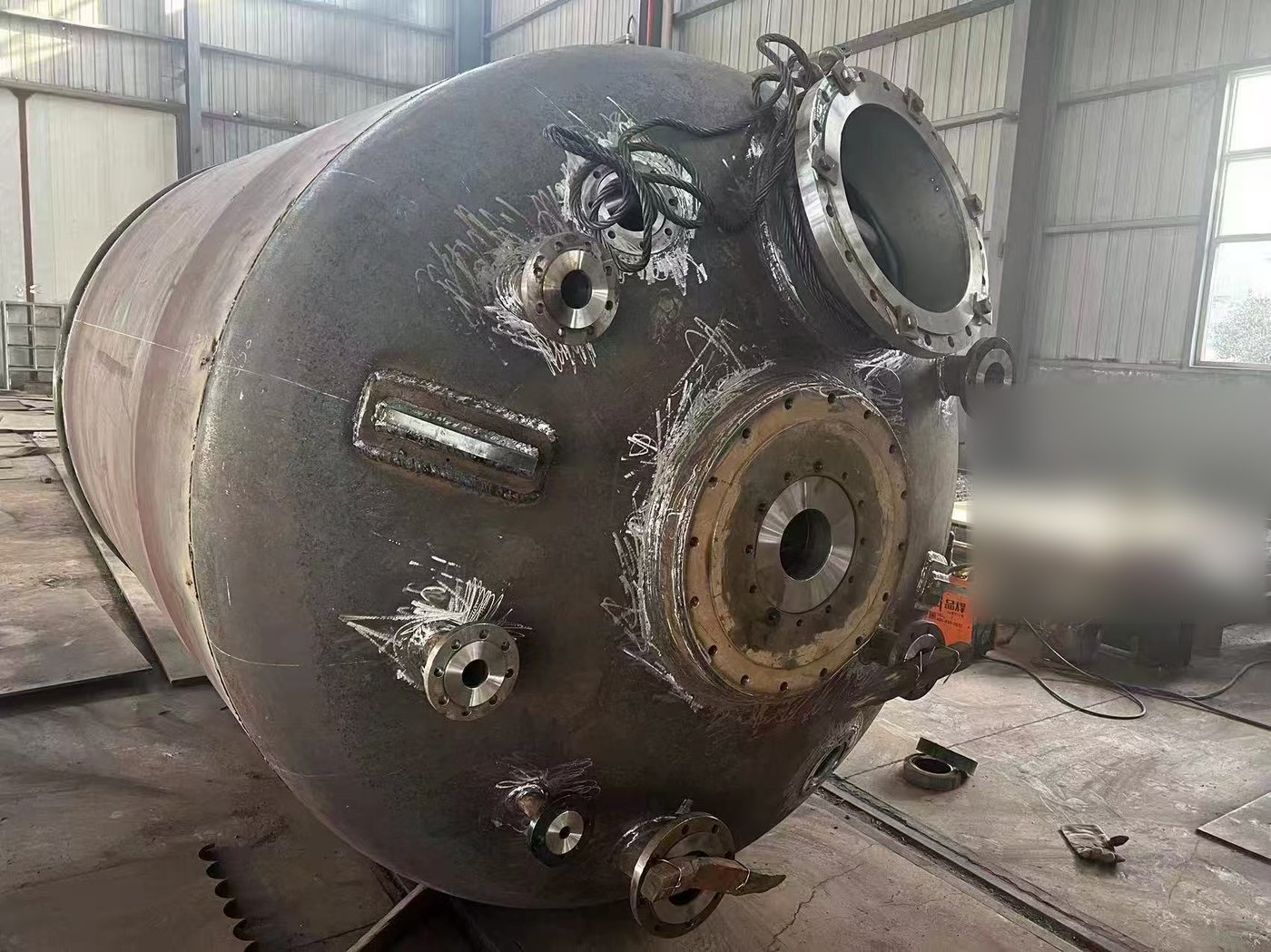
A reactor RFQ sent to a Chinese supplier needs eight items before it can be priced properly: process medium, design temperature in °C, design pressure in MPa, nominal volume in L, wetted material, certification standard, required delivery date and destination port. With all eight, a 3,000 L jacketed glass-lined reactor comes back as a fixed scope at USD 8,000–14,000 ex-works; with three of them missing, you get the cheapest build that technically matches the words, or a range too wide to budget against.
1. What a supplier does with a vague RFQ
Faced with 'glass-lined reactor, 3,000 L, please quote', the fabricator has one safe move: price the smallest, simplest vessel that satisfies the sentence. A plain jacket instead of a half-pipe coil. A packed seal instead of a mechanical seal. No sight glass, no dip pipe, no spare nozzle. The number that comes back is low, and it is not your vessel.
The alternative is a range. Suppliers who do not want to lose the enquiry quote USD 8,000–14,000 and wait for you to narrow it down. Both outcomes cost you a round of questions that a better RFQ would have avoided.
2. The eight items, in the order they move the price
- Medium — what is in the vessel, at what concentration, with which traces.
- Design temperature — in °C, plus the thermal shock case.
- Design pressure — in MPa, inner vessel and jacket separately, vacuum stated.
- Nominal volume — in L, plus the working volume you actually need.
- Wetted material — shell, lining, and the family you are choosing between.
- Certification — the standard, the documents, any witnessed inspection.
- Delivery date — a date, and what that date refers to.
- Destination port — the port and the Incoterm, so quotes compare.
3. The four process numbers
Medium
Glass lining is not universal. It handles inorganic and organic acids, organic solvents and weak bases at various concentrations. It does not handle hydrofluoric acid or fluoride-bearing media at all, phosphoric acid ≥ 30 % above 180 °C, or strong alkali above pH 12 at 100 °C. If your process touches any of those, put it in the first line of the RFQ — the answer is a PTFE lining, not a thicker glass coat. The PTFE family is PFA, PTFE, ETFE (F40), ECTFE (F30) or FEP (F46), applied by spray or by rotational coating.
Design temperature
Give design temperature, not operating temperature, and give both when they differ. A vessel running at 150 °C may be designed at 180 °C or 200 °C, and that figure sets the shell thickness, the flange rating and the gasket. Add the shock case: standard glass lining is rated for cold shock ≤ 110 °C and heat shock ≤ 120 °C, so a cold charge dropped into a hot mass is a lining constraint that belongs in the RFQ.
Design pressure
State design pressure in MPa for the inner vessel and for the jacket separately, and say whether either sees full vacuum. A jacket at 0.6 MPa and an inner vessel under vacuum are two different wall thicknesses and two different flange classes. 'Atmospheric' is not a value, and 'low pressure' is not one either.
Nominal and working volume
Give nominal volume in L and, separately, the working volume you need. The nominal series runs 50–30,000 L, and the model designation — Type K open, Type F closed — follows the industry-standard series, but usable charge is set by straight-side height and by where the agitator and nozzles sit. A 3,000 L nominal vessel holding 2,200 L of product is normal. If your batch is 3,000 L, write that the batch is 3,000 L.
4. The two build decisions
Material
One line for the shell, one for the wetted surface. Shell options are carbon steel, 304/316L, titanium, duplex stainless, Hastelloy or clad plate. The wetted surface is glass, or a PTFE lining over a carbon steel or stainless shell. If you need GMP mirror polish, hygienic no-dead-corner construction and a sterile-grade mechanical seal, that is a separate fabrication route and a separate price — do not append it as an afterthought.
Certification
Name the standard and say whether you need documents or a witnessed inspection: CE marking, ASME VIII design, GMP documentation, third-party inspection such as SGS, or GB/T. Then list the records you will actually file — high-voltage test result in kV, lining thickness in mm, material certificates, hydrotest pressure and duration. A supplier who cannot name those before the order will not produce them after it.
5. The two commercial terms
Delivery date
Give a date and say what it refers to: ex-works, FOB, or arrival at your site. Ex-works is the only date a fabricator fully controls. FOB adds inland haulage and export clearance. CIF or CIP adds a sailing nobody in the chain controls. If the date is hard because of a shutdown window, say so — it can affect which furnace slot the vessel takes, and sometimes the shell diameter.
Destination port
The port decides packing, not just freight. Exported vessels travel on saddles or in a frame, with nozzles blanked and the lining protected; a 30,000 L unit needs a cradle and a route survey. Put the port and the Incoterm in the RFQ so two quotations are compared on the same basis. A low ex-works number plus your own freight is not cheaper if the packing is not export-grade.
6. Five things not on the list that still change the price
These rarely appear in a first RFQ and each one moves the number: agitator type and motor power, seal arrangement (packed versus mechanical), heat-transfer surface (plain jacket, inner coil, immersion tube or half-pipe coil), nozzle layout, and internal finish. Drive sizing follows the mixing task rather than the tank size — a small vessel doing high-shear dispersion can carry a heavier motor than a large one turning slowly.
You do not have to specify these yourself. You do have to state what the vessel must do, so the specification can be written around the duty instead of around a price.
7. A template you can paste into an email
Ten lines: the eight above, plus duty and agitation.
- Duty: batch or continuous, cycles per day, batch size in L.
- Medium: composition, concentration, chlorides, solids, viscosity.
- Temperature: operating °C, design °C, shock case.
- Pressure: inner MPa, jacket MPa, vacuum yes or no.
- Volume: nominal L, working L, minimum batch L.
- Material: shell, wetted surface, internal finish.
- Agitation: what must happen in the vessel — dissolve, disperse, suspend, heat.
- Certification: standard, documents, witnessed tests.
- Delivery: date and basis (ex-works, FOB, CIF).
- Destination: port and Incoterm.
8. What to do before you send it
Write the eight lines, then mark the two you cannot answer. A supplier can price around a stated gap — 'lining to be confirmed, quote both glass and PTFE' — but not around silence. Ask for the reply as a numbered specification confirmation sheet, with internal dimensions, heat-transfer area, agitator power, seal arrangement, lining thickness, test values and unit weight written out, so you approve the vessel rather than a description of it.
Then compare quotations item by item. A quote that breaks the scope out line by line can be checked against another; a single lump sum cannot. If a competing quotation looks cheaper and does not say which agitator, which seal and which jacket it includes, that omission is usually the answer to why.