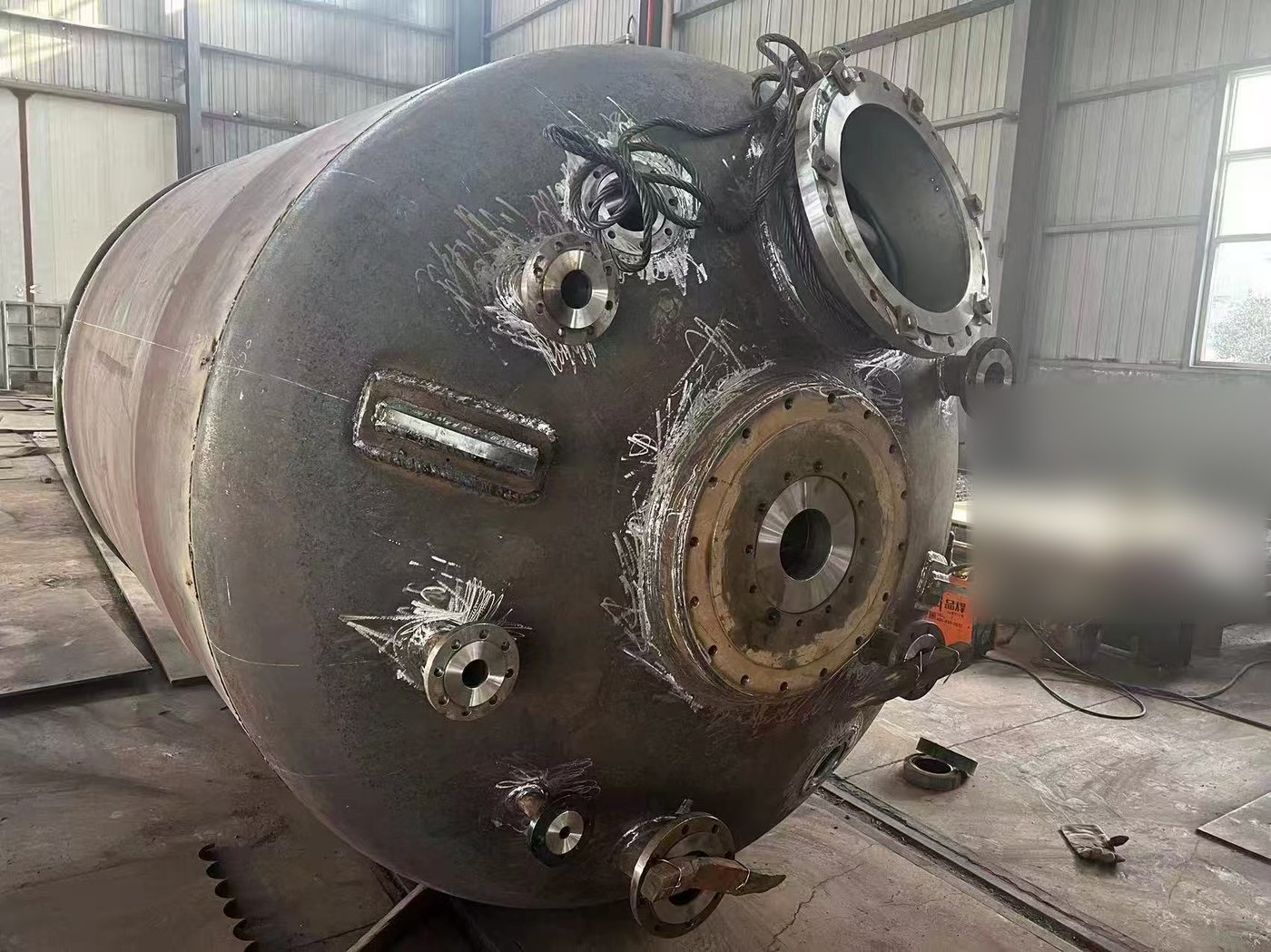
A reactor built in China for a European plant needs CE marking under the Pressure Equipment Directive 2014/68/EU as soon as design pressure exceeds 0.5 bar, and the conformity route is fixed by category — I to IV — read from Annex II by volume in litres against pressure in bar. ASME Section VIII Div. 1 with a U stamp is a separate question, asked by US jurisdictions, insurers and most Gulf project specifications, and it does not replace the PED: one vessel can need both. GB/T 150-2011 and TSG 21-2016 apply when the vessel is installed in China, not when it leaves the port.
1. The four regimes answer four different questions
PED 2014/68/EU is law, not a code. It does not tell a fabricator how thick to make a shell; it tells the manufacturer what evidence must exist before the vessel is placed on the EU market. The evidence route comes from Annex II, and it is chosen per chamber.
ASME BPVC Section VIII Div. 1 is a design and fabrication code. It becomes mandatory only where a jurisdiction adopts it, or where a contract or insurer writes it in. The visible proof is the U stamp and the Manufacturer's Data Report signed by an ASME Authorised Inspector.
GB/T 150-2011 is the Chinese design standard; TSG 21-2016 is the Chinese regulation that sits on top of it. For a vessel installed in China the manufacturer needs a special equipment manufacturing licence, and the user registers the vessel locally.
TR CU 032/2013 is the Eurasian Customs Union regulation, marked EAC. It applies in Russia, Belarus, Kazakhstan, Armenia and Kyrgyzstan, and it carries its own documentation language requirement.
2. Where each one is actually mandatory
European Union and EEA
CE under the PED, without exception, for any vessel above 0.5 bar design pressure. Below Category I the vessel falls under Sound Engineering Practice: it must still be sound, but it must not carry the CE mark. Category I can be handled with internal production control and a self-declaration; from Category II upward a notified body is involved in design, production, or both, and the four-digit number on the plate must trace to a body listed in NANDO.
Great Britain runs UKCA marking under the Pressure Equipment (Safety) Regulations 2016, and whether CE is accepted there depends on the current UK position — confirm it before the nameplate is stamped.
United States and Canada
Section VIII Div. 1 is adopted into law by the US states and the Canadian provinces. Canada additionally requires a CRN registration in every province where the vessel is installed, and a U stamp alone does not produce one — it is a separate filing against the provincial drawing set.
Russia, CIS and the Gulf
EAC certification or declaration under TR CU 032/2013, with a Russian-language technical file. In the Gulf there is no regional stamp: ASME VIII Div. 1 is the default in project specifications, and vendor listing with the operator is a separate gate that usually takes longer than the stamp itself.
India and Southeast Asia
India has no single equivalent. Contracts cite ASME VIII or IS 2825, and third-party inspection against your ITP carries the real weight. Malaysia and Indonesia run registration and inspection at commissioning rather than at the factory — the paperwork attaches to the installed vessel, so the design submission has to start early.
China
If the reactor is installed in a Chinese plant, TSG 21-2016 applies, the fabricator must hold a Chinese manufacturing licence, and the user registers the vessel. A vessel built for export only does not need that licence — but the same drawing cannot simply be reused for a domestic sale.
3. The traps, in the order they cost money
- The jacket and the inner vessel are two chambers. A 3,000 L reactor with a 0.6 MPa jacket and an atmospheric inner vessel gives two separate Annex II reads, often two different categories. The higher one governs the assembly. A supplier who quotes a single "CE" without asking what sits in the jacket has not done the calculation.
- An assembly is not the sum of its parts. If you buy the reactor, a receiver and a condenser as one package piped together, the assembly needs its own conformity assessment. Split the order and each item is assessed alone.
- SEP is not a discount CE. A CE mark on a vessel below Category I is a false declaration. Ask for the category and the calculation behind it.
- The glass lining is outside the certificate. PED and ASME assess the pressure boundary. Lining thickness in mm, the high-voltage test in kV and the thermal shock limits — cold ≤ 110 °C, heat ≤ 120 °C — are your specification, not the notified body's, and they belong in a numbered spec sheet you sign.
- A U stamp belongs to a shop, not to a model. Check the certificate scope and the address on it, and check who the Authorised Inspector will be. A data report signed by an inspector who never saw the hydrotest is a paperwork problem you inherit.
- Safety accessories are separate. A safety valve or bursting disc on the jacket needs its own PED assessment. It is not covered by the vessel's certificate.
- Material certificates. Ask for EN 10204 3.1 mill certificates as the floor, and 3.2 where the notified body or the end user calls for it. Plate grade and heat number must match the data report.
4. What actually drives the calendar
Certification rarely delays the start of fabrication; it delays the finish. The vessel is rolled, welded, lined and fired on the shop's schedule, and the certificate lands at the end — which is exactly when a missing notified body slot becomes expensive.
Three things sit outside the factory's control. The notified body's design examination queue, where the module requires one. The pressure-test witness, which is a fixed appointment — miss it and the vessel waits, occupying floor space. And the Authorised Inspector's itinerary on a U-stamped job.
We do not quote certificate durations from memory. The date comes from the notified body's written quotation, and it belongs in your project schedule before the fabrication order is released, not after. Put it on the purchase order as a milestone with a named module and a named body.
5. What to put on the enquiry
Destination country and site. Fluid and fluid group for the inner vessel and for the jacket, separately. Design pressure in MPa and design temperature in °C for each chamber. Nominal volume in litres. Code, and the module if PED. The notified body or TPI agency you want named. Material certificate level. Language of the final documentation pack.
That list is short, and it is the difference between a quotation you can compare and one you have to re-open. A supplier who cannot answer the fluid group question cannot give you a category, and the category is the only thing that tells you what the certificate will cost.
What to do next
Write the certification requirement into the enquiry, not into the purchase order. Ask each supplier for the category calculation, the named notified body and the module. Compare those answers before you compare the price — a vessel quoted 12 % cheaper with the wrong conformity route is not cheaper.
If you are buying for a plant in a market with no single mandatory stamp, decide in advance which code you will accept as evidence and put it in the specification. That decision is cheaper made in the office than at the dock.