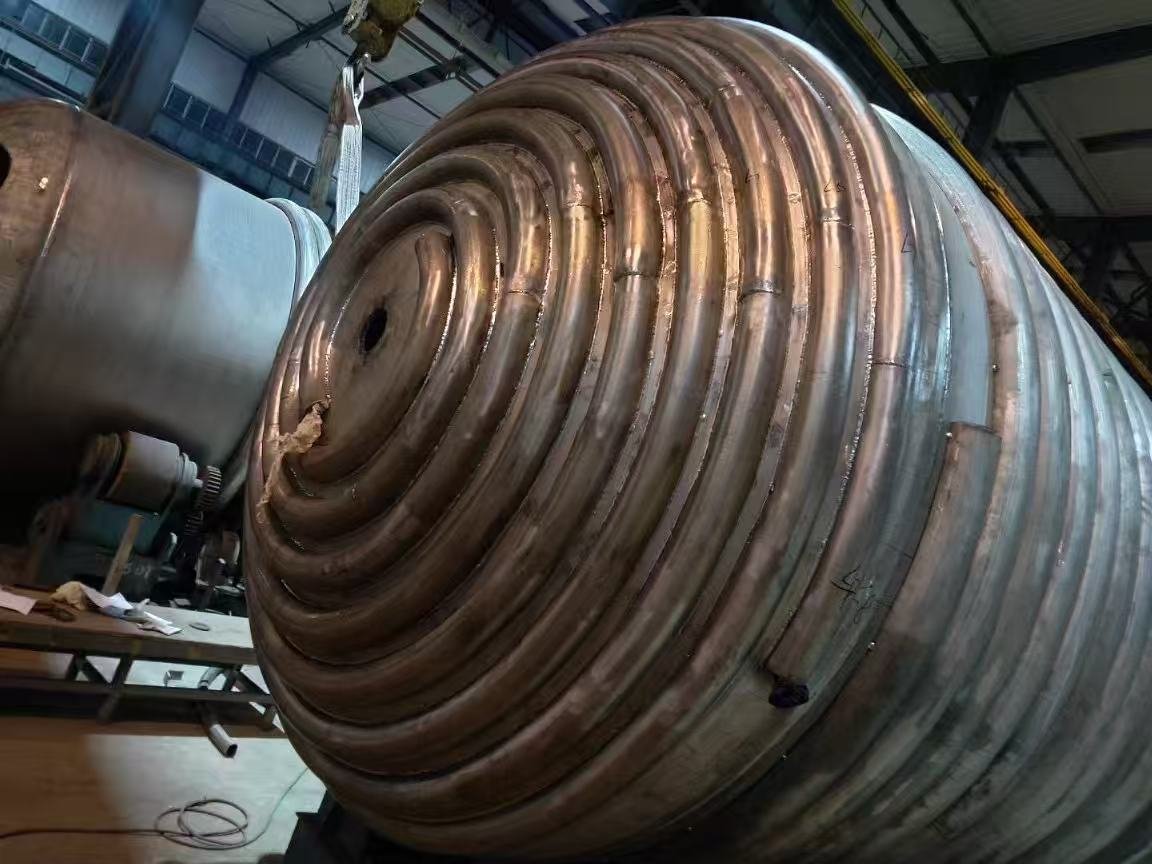
The first 24 hours after a new reactor arrives should run in four blocks: a 2-hour unpacking and document check before the delivery note is signed, 4 hours of placement and levelling, a clean-water fill and hold of at least 2 hours, and a staged agitator run in that same water up to design speed. Nothing but water enters the vessel until the glass lining is checked against the high-voltage test certificate in kV and the lining thickness readings in mm.
1. Hours 0–2: unpack, count, and check documents before you sign
A delivery note is a receipt for boxes, not for a working vessel. Open every crate, lay the parts out and count against the packing list while the driver is still at the gate. A nozzle blind or a seal seat that was never shipped is a two-week conversation once the truck has left.
Three documents decide whether the vessel is accepted: the high-voltage test certificate for the lining, the lining thickness readings in mm, and the pressure test record for both the inner vessel and the jacket. Ask for them now, not at the end of the day. Those two numbers — the kV figure and the minimum thickness in mm — are what you will be asked about for the next ten years.
Photograph the lining through the manway under a torch before anything is installed. Any chip, bubble or discolouration is recorded against the vessel serial number on day one, not on day forty. Lift by lugs and trunnions only; never by a nozzle, an instrument port or a jacket connection.
2. Hours 2–6: place it, level it, earth it — and leave the process piping off
Set the vessel on its foundation, shim under the support ring or the legs, and level to the tolerance on the general arrangement drawing. If the drawing is silent, 1 mm per metre across the vessel flange is a workable target. Bolts go in finger-tight; final torque waits until the vessel has been through its first heat cycle.
Resist the urge to connect everything. For the first day, connect only what the test needs: a water line, a drain, a pressure gauge and the jacket connections. A leak that appears behind three metres of newly installed piping is a leak you find on day three, not day one.
On a mechanical seal, compare the seal drawing with what is in the box — stationary seat, spring set, secondary O-rings — and confirm the barrier or quench fluid route before the shaft turns. Earth the vessel and the motor separately. A glass-lined vessel feeding a PTFE-lined pipe run is not a reliable earth path.
3. Hours 6–12: water in, hold, and walk every joint
Fill with clean water at ambient temperature to the design liquid level, not to the brim. Hold for at least 2 hours and inspect every nozzle, the manway, the flange, the jacket inlet and outlet and the bottom outlet with a torch and a dry cloth. Water is the only medium that belongs in the vessel on day one.
Test the jacket separately, at the pressure printed on the specification confirmation sheet and not one bar more. The jacket test is where glass-lined vessels are most often damaged: a hydrostatic test taken past the stamped value proves nothing and can crack the lining at a repair cost approaching the price of the vessel. For scale, a 3,000 L jacketed glass-lined reactor is a USD 8,000–14,000 item ex-works; a lining repair on the same vessel is a serious fraction of that, before freight.
Respect the thermal shock limits from the first time the jacket is used. Cold shock ≤ 110 °C, heat shock ≤ 120 °C. That rules out steam into a cold jacket on the first afternoon, and cold water into a hot jacket when the test ends. Bring the jacket up and down slowly — the first 24 hours are the wrong time to discover how fast the lining accepts a step change.
4. Hours 12–18: run the agitator in the water already in the vessel
Confirm rotation direction first, with the coupling guard off and the vessel empty, for a few seconds, against the arrow on the drive. Running an agitator backwards for an hour is a quiet way to unscrew a shaft nut or damage a mechanical seal.
Then, with the hold water still in the vessel, run in stages: 10–15 minutes at low speed, then up to design speed. Watch motor current against the nameplate rating, gearbox temperature, vibration at the bearing housing, and the seal for any drip. A slight, even weep from a packed seal during run-in can be normal; a mechanical seal should stay dry.
If current climbs steadily instead of settling, stop and check baffle position, impeller clearance and direction again. Do not run a glass-lined or PTFE-lined vessel with the agitator turning and no liquid over the impeller beyond the few seconds needed to confirm rotation.
5. Hours 18–24: instruments, relief device, and the sign-off sheet
By the end of the first day the vessel should be instrumented and proven cold: pressure gauge and transmitter checked against a reference, relief device set and tagged at the value on the specification sheet, jacket and vessel drains proven, seal barrier fluid at its stated pressure. Record actual numbers, not ticks in boxes.
The sign-off sheet should carry the vessel serial number, the lining kV test value, the minimum lining thickness in mm, the inner vessel and jacket test pressures with hold times, every agitator speed run with the current drawn at each, seal leakage observed, and the name of the person who watched each step. That sheet is what a plant manager in India, Thailand or Brazil needs three years later when the same vessel is asked to take a harder duty.
6. What must not happen in the first 24 hours
- No process medium. The lining media limits are not negotiable: no hydrofluoric acid or fluoride-bearing media, no phosphoric acid at 30 % or above over 180 °C, no strong alkali above pH 12 at 100 °C.
- No test pressure above the stamped value on the inner vessel or the jacket.
- No thermal step beyond cold shock ≤ 110 °C or heat shock ≤ 120 °C.
- No lifting by nozzles, and no welding, grinding or impact near a PTFE-lined shell.
- No tightening of cover bolts on a hot vessel. Torque cold, then re-check at ambient after the first heat cycle.
7. Before the truck arrives
Have the packing list, the high-voltage certificate, the lining thickness record and the general arrangement drawing on the floor before the vessel reaches site. Name one person for each of the four blocks and give them the recording sheet, not a verbal briefing.
If a number is missing from the specification confirmation sheet — jacket test pressure, seal arrangement, agitator speed, design liquid level — stop and get it in writing before the water goes in. Everything on that sheet is cheap to correct by email and expensive to correct with the vessel full.